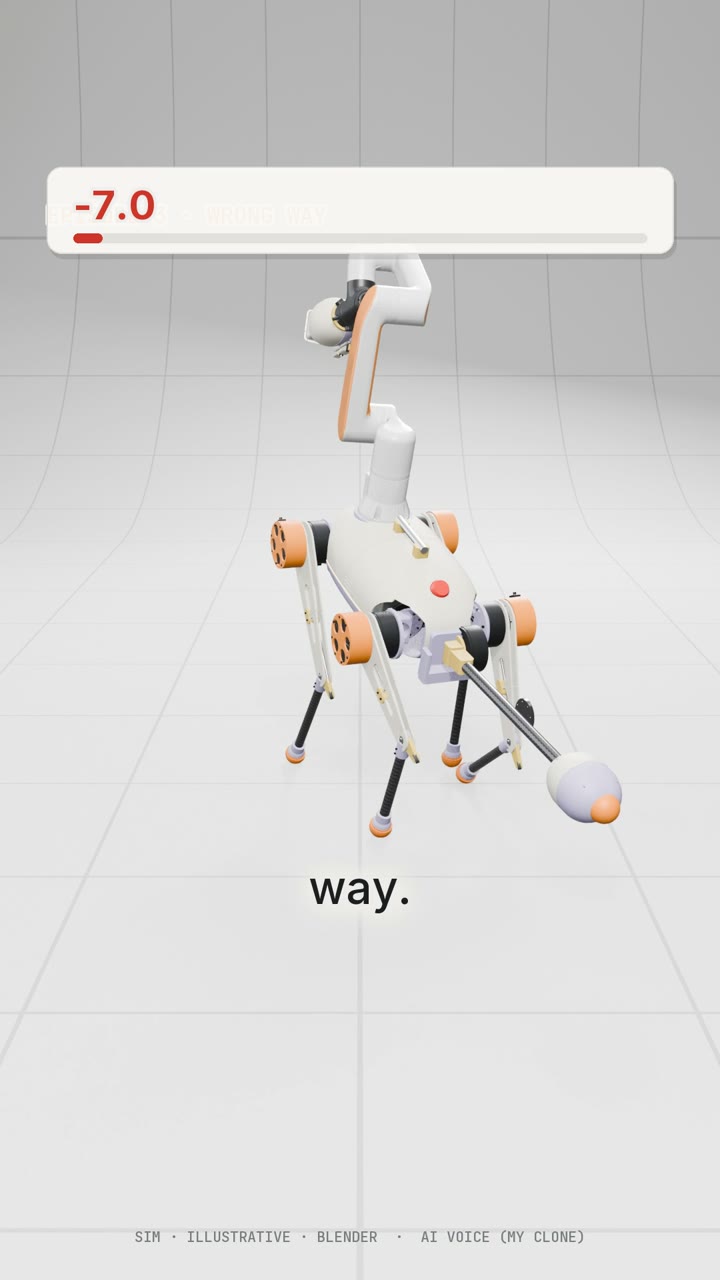
I asked Claude what physical body it would design for itself. We ended up with a funny bird: four legs, a robot arm for a neck, and a beak that is actually a hand.
Getting there took a lot of changes. The useful part was watching a character sketch collide with motor sizes, reach, packaging and weight. Here are the design experiments and three finished vertical films from that process.
Design and simulation · 22 October 2026. Heron has not been built as a complete physical robot. The current walking, falls and swarm sequences are scripted illustrations; there is no trained walking policy for this design. The grasp sequences use MuJoCo contact simulation.
First we chose a body. Then we kept changing it.
The opening concepts were deliberately broad: Octo, a soft exploratory body; Heron, a long-necked walker; Lantern, a padded ballbot; and Colony, sensing and manipulation distributed around a room. Heron gave us an interesting combination of close observation and manipulation. The initial tripod proposal evolved into the quadruped shown here.
We explored exposed printed structure, a softer pebble-like shell, a longer neck and a more animal-like posture. These were design studies, not different working robots. A friendly silhouette was useful, but it could not answer where the mass should go or how a knee would carry it.
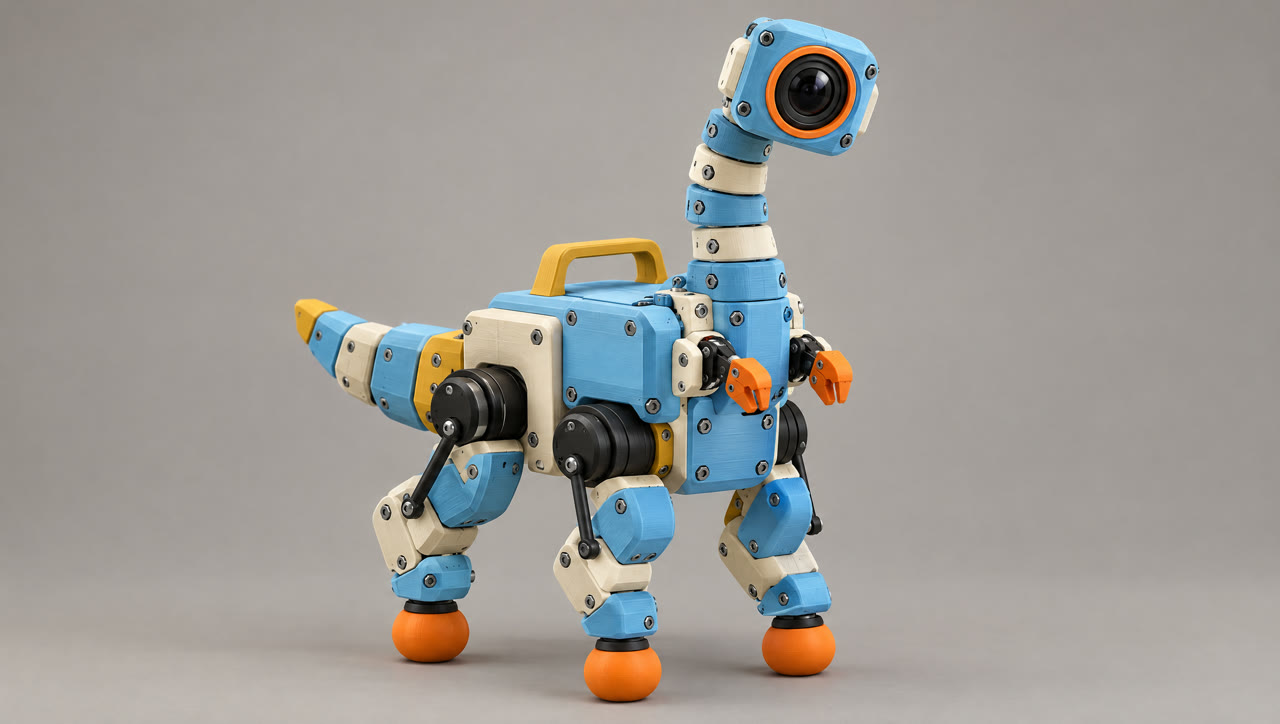
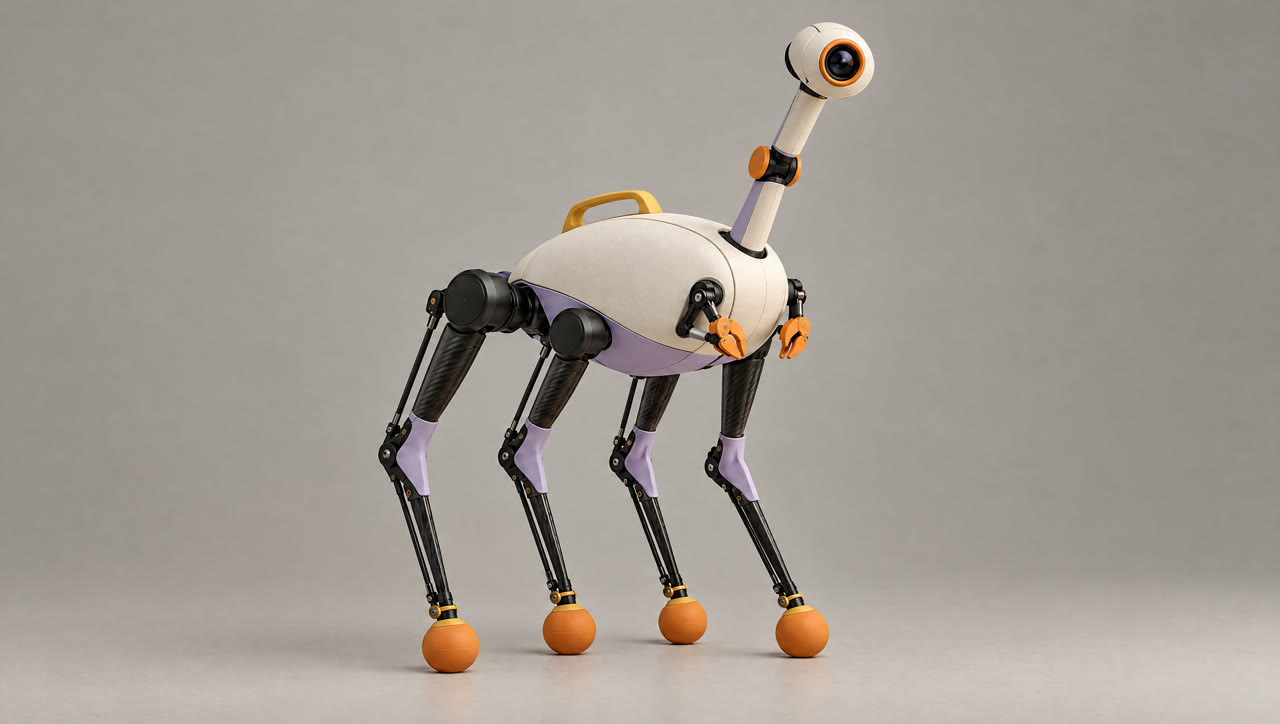
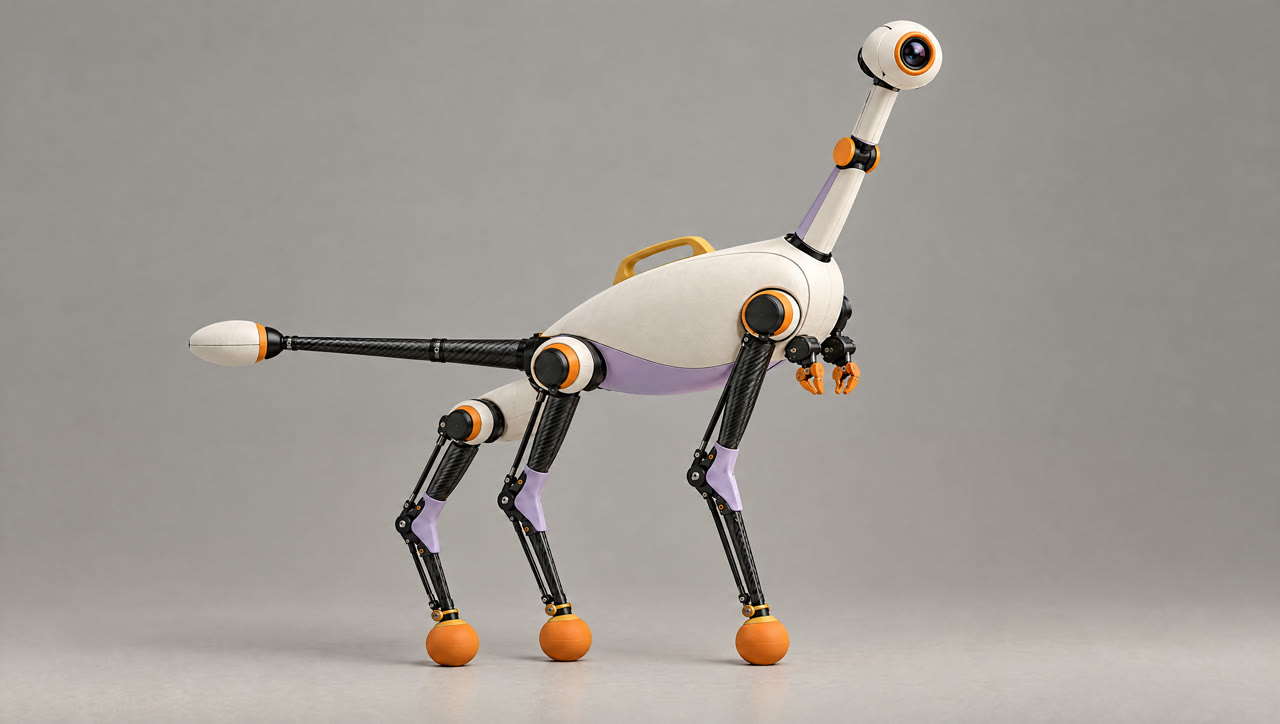
The real components changed the proportions.
Once the design used the actual sizes of the SO-101 arms, they dominated the body. The neck looked like a lamp post. The next passes folded and repositioned the arms, thickened the neck and gave the head and tail more presence. Leg studies introduced GO-M8010 motor geometry, a four-bar knee arrangement, split printed thigh parts and carbon shins.
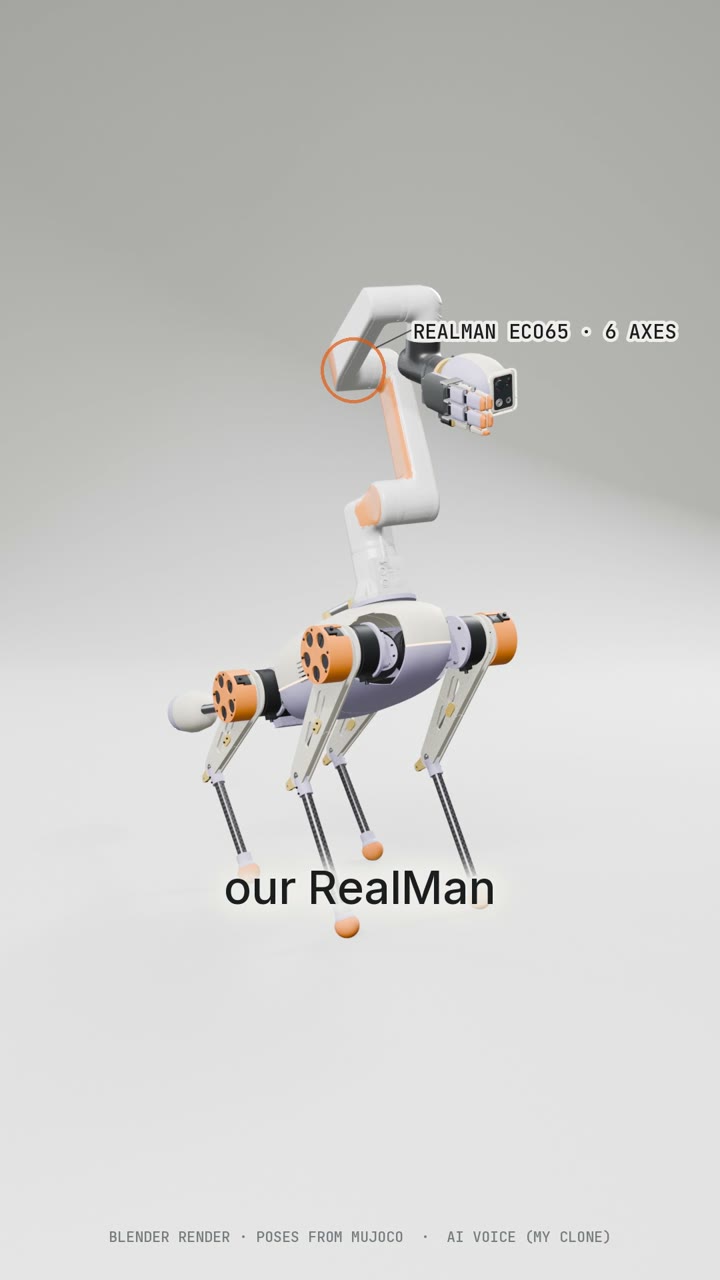
Then I asked a more direct question: what if our RealMan ECO65 became the neck, and the head became the gripper? That removed the two separate arms and brought the sensor right to the manipulation point. It also made the weight problem much harder.
The mass estimate rose from roughly 16.2 kg for the earlier layout to about 22 kg for the ECO65-and-beak concept. Those are design estimates. The modelling discussion found a discrepancy between the arm’s listed mass and the sum of its URDF link masses; a lumped calculation cannot settle real stability or motor heating.
The current render puts the body at an approximately 20-degree incline and the battery in the tail. The film’s roughly 13 cm forward support margin and 22 kg total come from an earlier simplified estimate and have not been recomputed for the latest hand. They are not load-test results. Continuous knee loading remains an engineering question.
The beak became a tactile hand.
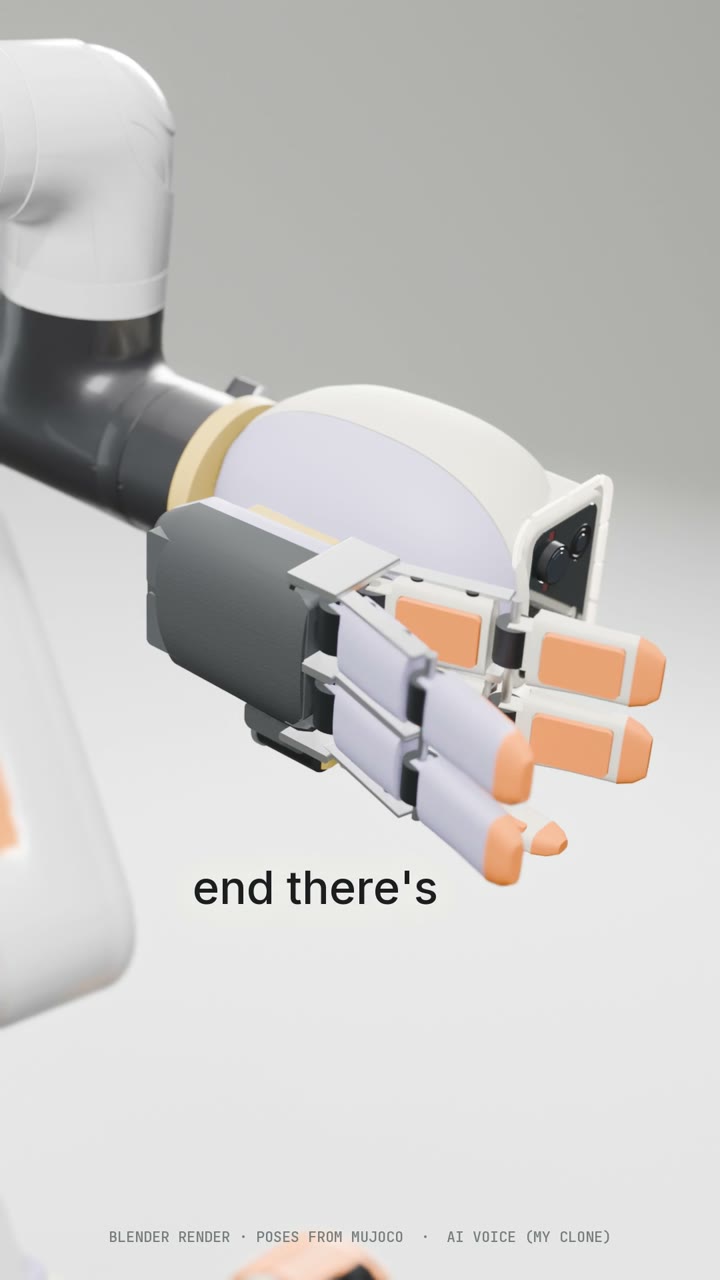
The current “Schnabel” design has four fingers arranged as two opposing pairs, plus a thumb that can swivel to join either pair. Four finger servos and two thumb servos give six actuators. Orange compliant pads sit over the proposed tactile sensing surfaces.
The mug and egg sequences go further than posing an object in a gripper. They were produced with contact, friction, finger actuators and pad touch sensors in MuJoCo. The egg closing loop uses the simulated tactile feedback. The films show roughly 4 N for the mug and under 1 N for the egg, depending on the sampled frame. These are simulated forces; a rendered unbroken egg is not a physical fragility test.
The eye connects back to the sensor project.
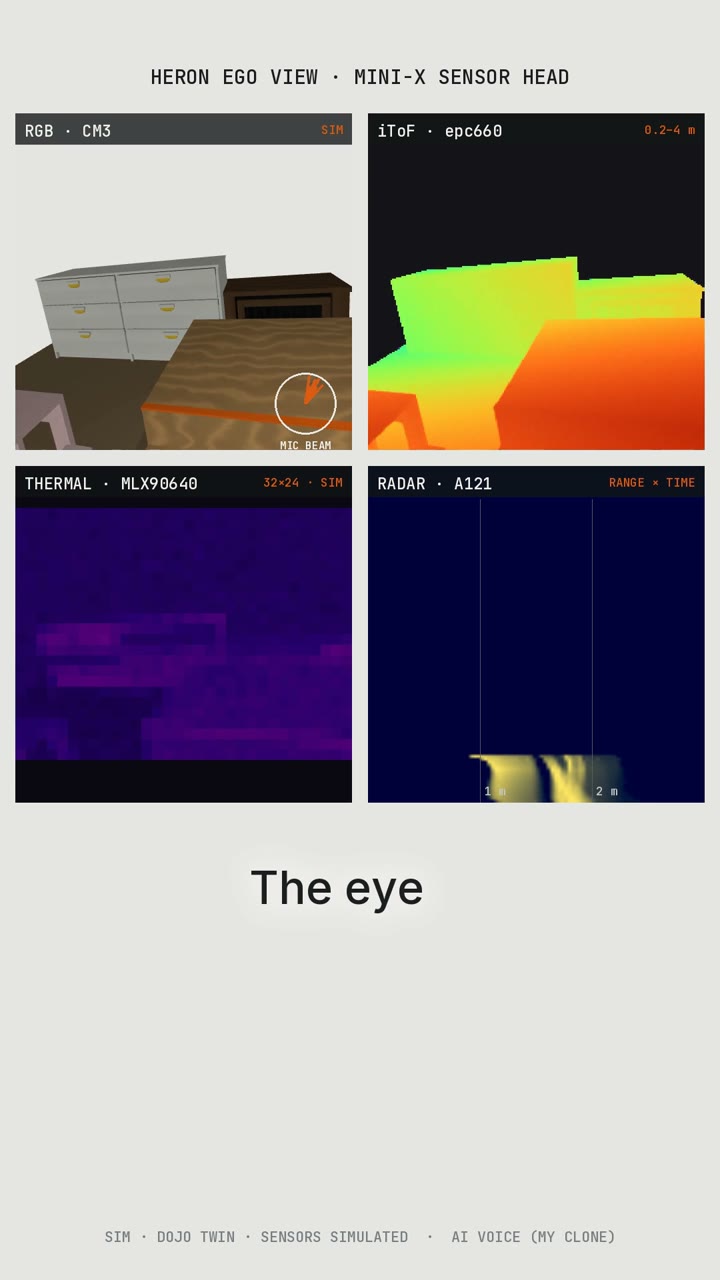
The front module is the Mini-X concept: RGB, iToF depth, low-resolution thermal, radar and stereo microphones. The multimodal eye view is simulated, and some reused dojo shots show an earlier robot version. This connects Heron to the sensor experiments without pretending the integrated head already exists.
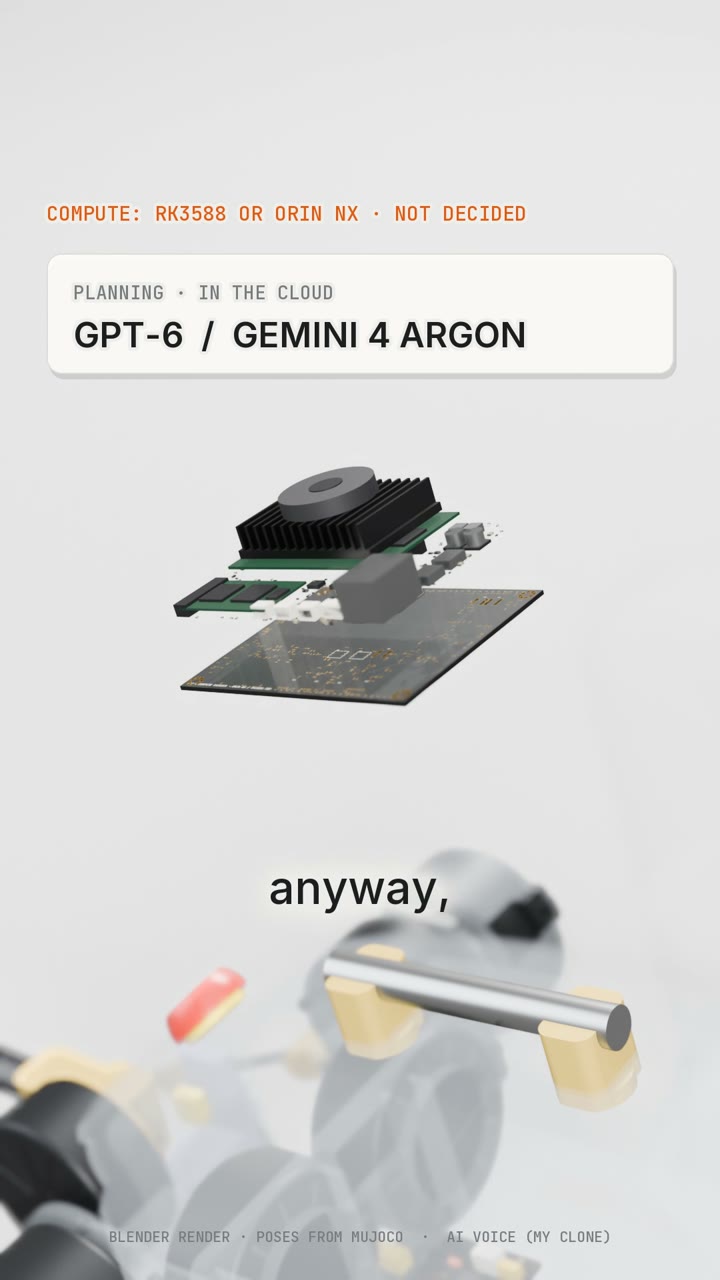
Onboard compute is still open between the Rockchip RK3588 and Orin NX directions. The proposed split puts fast balance and tactile loops onboard, with higher-level planning in the cloud. The rendered electronics include a compute carrier, 24 V power board, two RS485 hubs and a hand board. Detailed copper, components and silkscreen in a render are not a fabricated or validated PCB.
Three films. Three ways into the experiment.
These are the existing 9:16 cuts, presented here as design films. They use my authorised synthetic voice, Blender renders and MuJoCo poses. The original exports are 1080 × 1920; these web copies are 720 × 1280 with the same framing and audio.
9:16 · 2:06 · DESIGN / SIMULATION
Meet Heron
The latest launch cut: the arm-neck, beak hand and three proposed use cases. Includes two labelled shots from the first robot version.
Open video ↗9:16 · 1:59 · DESIGN / SIMULATION
Inside the hardware
The motor layout, tactile hand, sensor head, electronics and exploded assembly. Contact grasps are simulated.
Open video ↗9:16 · 1:46 · DESIGN / SIMULATION
How it could learn to walk
An RL explainer covering tasks, reward, domain randomisation and sim-to-real. Walking and falls are scripted illustrations.
Open video ↗What the RL film is explaining.
The reinforcement-learning explainer walks through tasks, rewards, penalties, policy updates, parallel environments, domain randomisation and the gap between simulation and hardware. The falling and walking Herons illustrate those ideas. They do not show a completed training run or a successful transfer to a physical robot.
The launch film keeps some awkward details: two clips use the first robot version, and the head-hold shot contains a frame with about 13 mm of inverse-kinematics drift. The design has personality now. The next useful milestone is more ordinary: build the first leg, check its loads, and find out whether the proposed body can stand before claiming it can walk.
Based on the “AI physical body design” Claude conversation and the saved Heron design/film assets, checked 22 October 2026. Earlier concept images are illustrative. Current films distinguish contact simulations from scripted motion. No autonomous walking, production-ready electronics or physical grasp validation is claimed.