
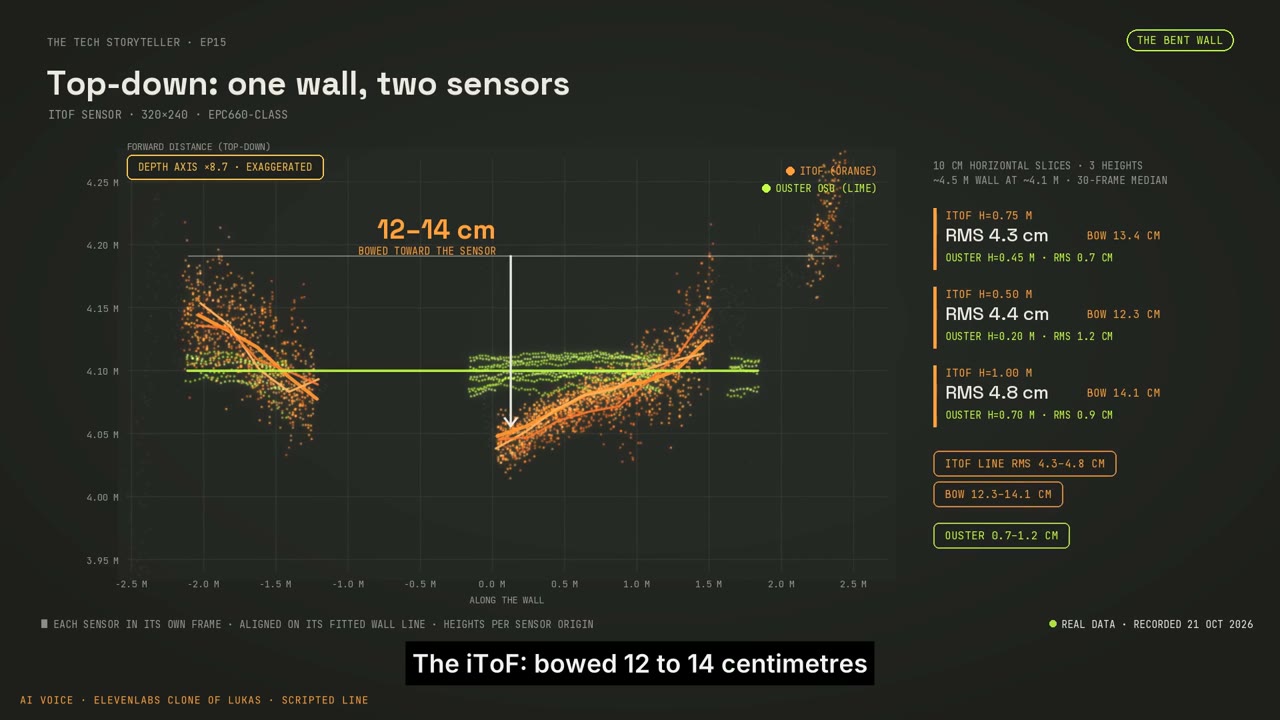
The iToF sensor reports a straight wall bowed 12–14 cm. Longer exposures reduce noise, receiver bugs are patched and multiple causes investigated, yet frequencies disagree by 22 cm. A one-wall fitted correction is local only; cyclic error and spill remain hypotheses, while TMF8829 dToF is considered for a wrist sensor.
My wall was straight. The Ouster comparison showed it as straight. The iToF point cloud bowed 12–14 cm towards me across roughly four and a half metres. After the bring-up in Episode 14, getting data was no longer the only question. I needed to know what was wrong with it.
Noise and bias stopped looking like the same problem.
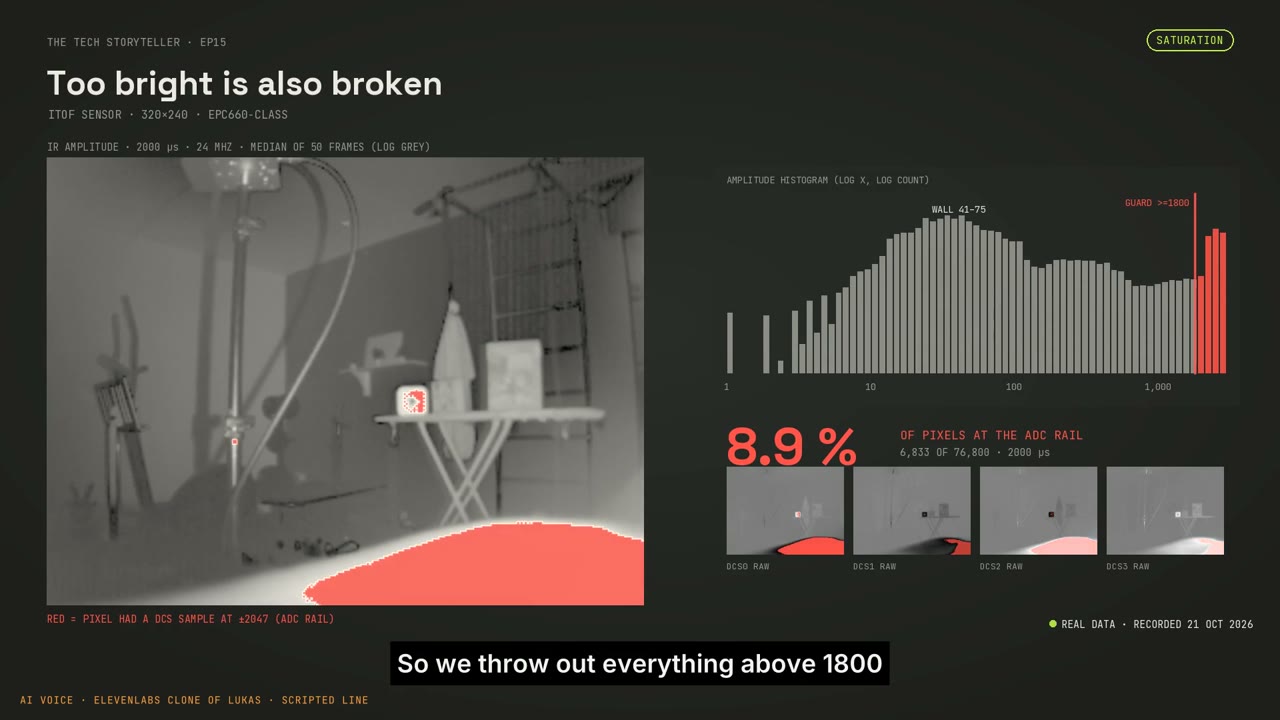
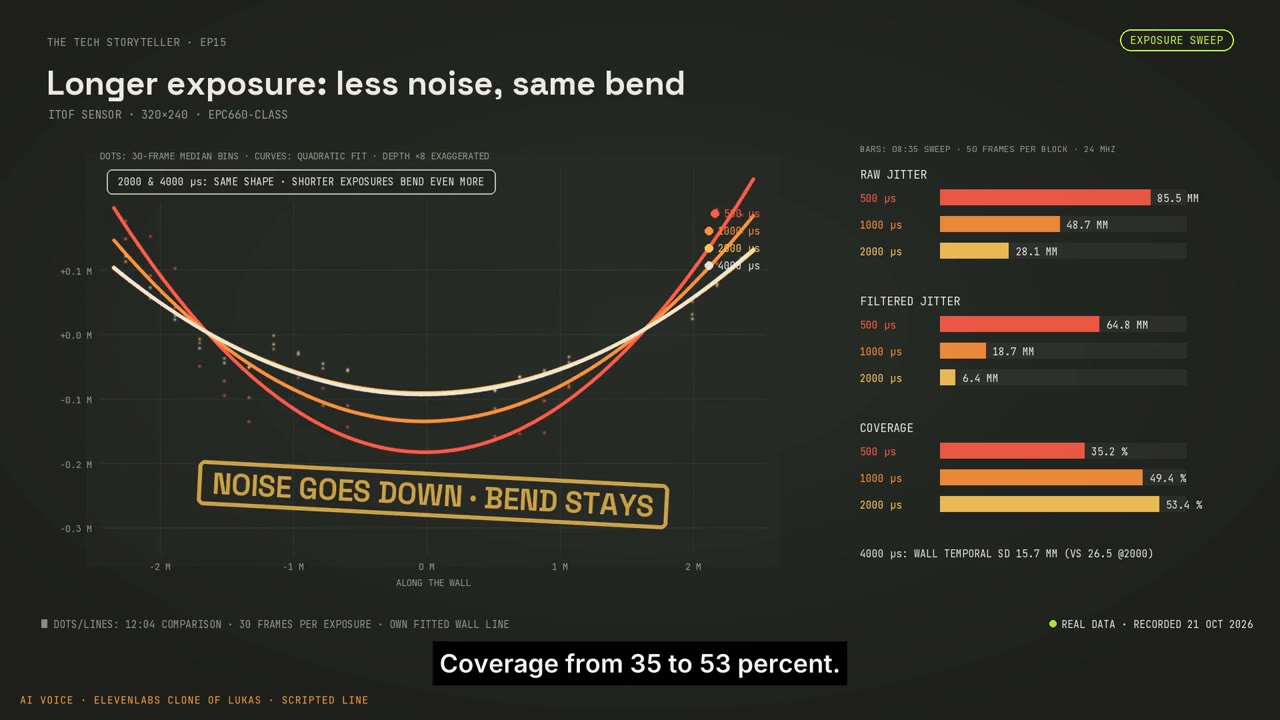
Increasing integration from 500 to 2,000 microseconds reduced raw jitter from 85 to 28 mm and filtered jitter from 65 to 6 mm in this test. Coverage improved from 35% to 53%, while 8.9% of samples reached the ADC rail. The cleaner point cloud still had a shape problem.
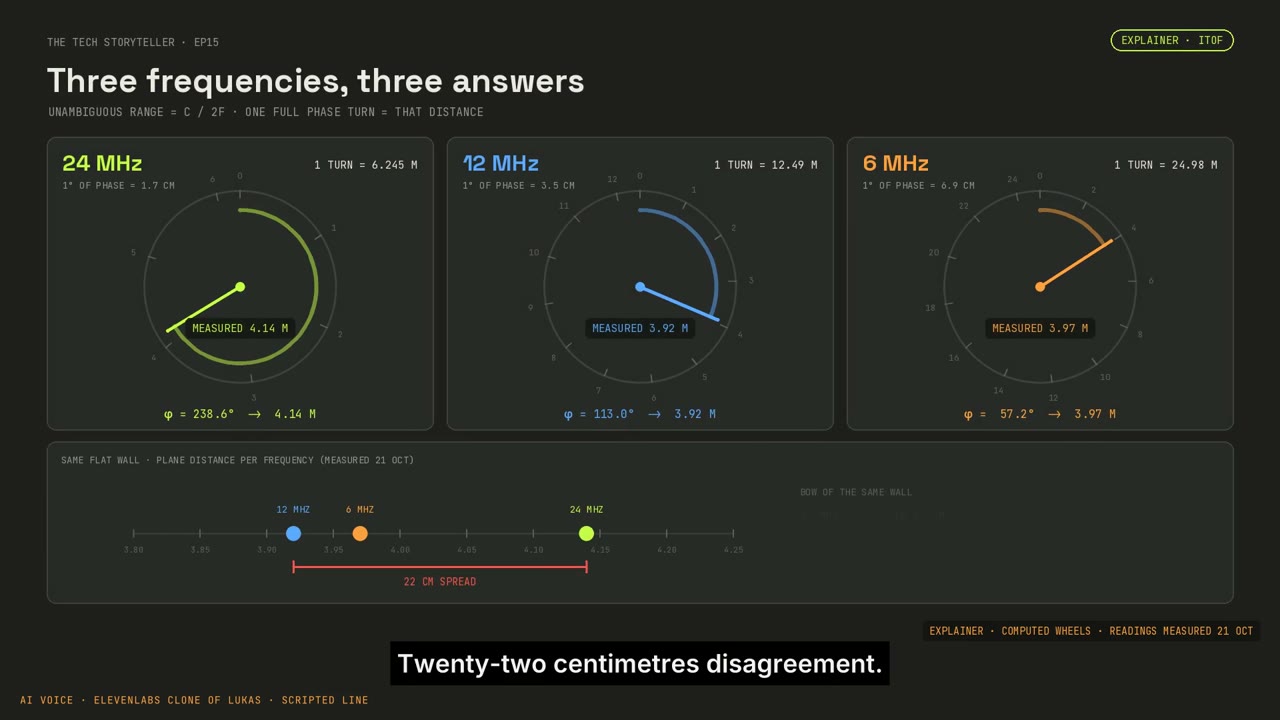
We patched three receiver issues: unchecked packet length, corrupted frames passed on as fresh data, and byte resynchronisation. Then we investigated the filter, exposure, the lens model, the viewer projection and the factory correction tables. Three modulation frequencies still gave 4.14 m, 3.92 m and 3.97 m for the same wall. That 22 cm disagreement mattered more than an attractive display.
The curve fit was a checkpoint.
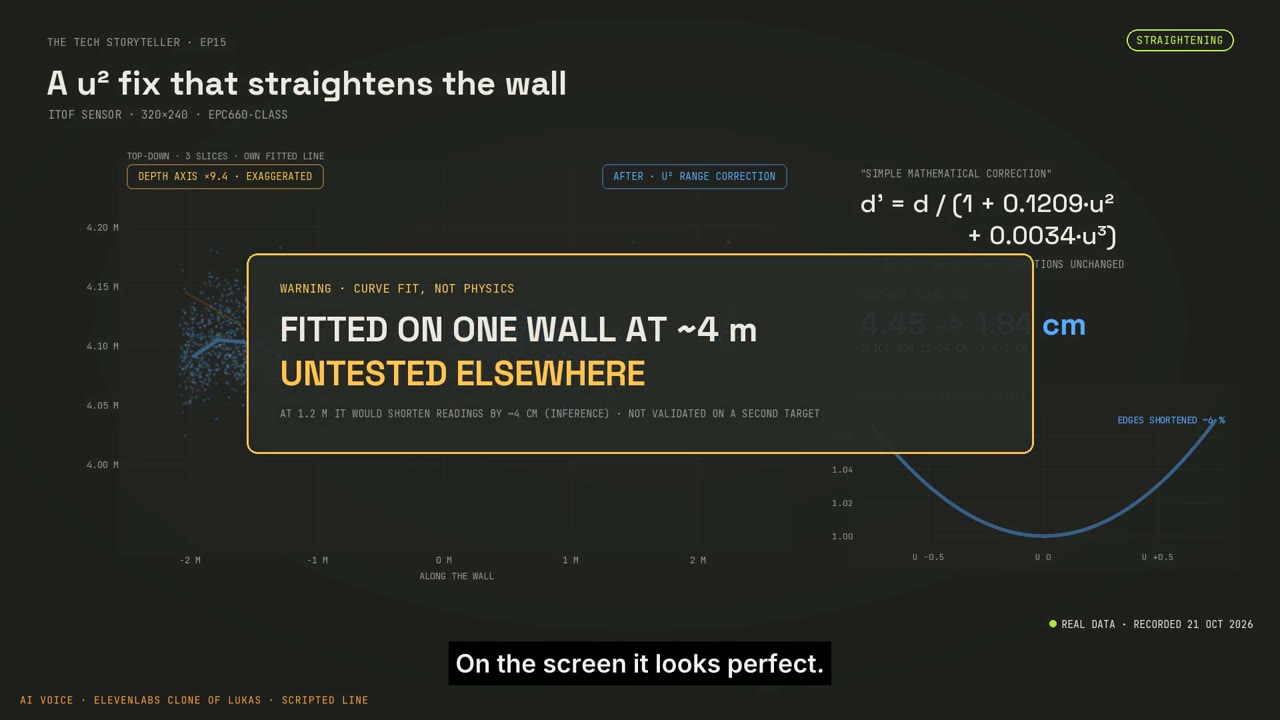
A fitted correction improved plane RMS from 4.45 to 1.84 cm on this wall at roughly four metres. It was not a calibration validated across distances. Mixed pixels, lens spill and cyclic error were possible explanations, but the cause of the bow remained unresolved.
The next useful checks were a range sweep and a lens-hood spill test. We also considered the TMF8829 direct-ToF route for a wrist sensor. It changes the resolution and range compromise; it had not yet won a physical head-to-head comparison.
This episode is an ongoing measurement investigation. The useful result is a better diagnosis of what remains unknown. The cross-episode writeup puts the numbers beside the original sensor idea and explains how they changed the design questions.
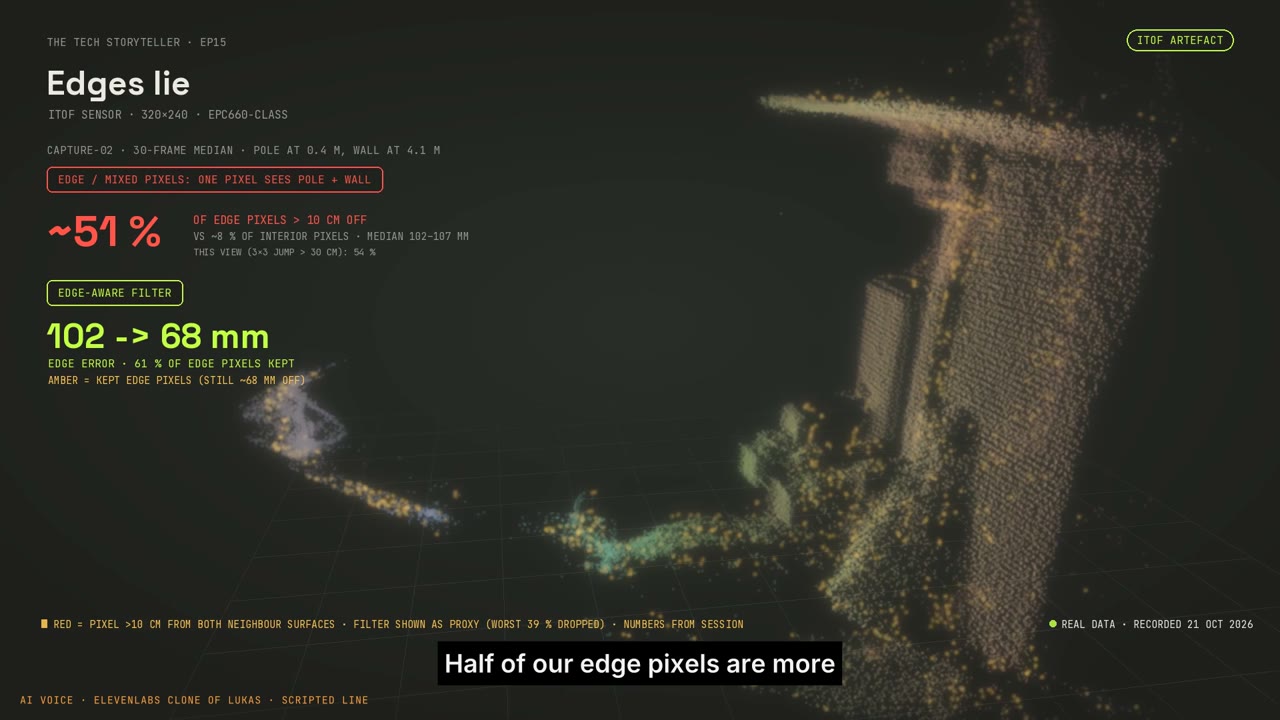
Scope of this episode: Bent-wall cause unresolved; local curve fit is not validated across ranges; no dToF head-to-head yet.
Based on the published episode and its production record. YouTube publication verified 22 October 2026. Stills are extracted from the released episode. Captions distinguish recorded evidence, reconstruction, simulation and illustrative material.